The Wealth You Cannot See
If you own a home in Southern California, there is a good chance you are wealthier than you realize. Not because of your paycheck or your savings account, but because of the equity that has been quietly building in your walls while you were living your life.
Equity is the difference between what your home is worth and what you owe on it. In a market like Southern California, where values have climbed steadily for decades with only a couple of serious interruptions, that equity can become substantial fast. And in 2026, despite the rate environment that has cooled transaction volume, values have continued to trend upward in most of the region.
This report breaks down what homeowners have gained this year, county by county, what is driving the growth, and what it means if you are weighing a sale.
Why Values Keep Climbing in a Slow Market
It seems counterintuitive. Rates are high, transactions are down, affordability is stretched, and yet home values are still rising. Here is why.
The single biggest factor is inventory, or the lack of it. Over 75% of existing homeowners hold mortgage rates below 5%, and many hold rates in the 3% range from the 2020-2021 refinance boom. Those homeowners have almost no financial incentive to sell, because doing so means giving up a low-rate mortgage and taking on a new one at 6% or 7%. So they stay put, and the supply of homes for sale stays historically low.
When supply is low and demand, even reduced demand, still exists, prices hold or rise. That is the structural reality of Southern California housing in 2026. The rate lock-in effect is keeping a lid on inventory, and that lid is supporting values.
Add to that the region's long-term housing shortage. Southern California has been underbuilding for decades. Population growth, household formation, and migration into the region continue to outpace new construction. That fundamental undersupply provides a floor under values that does not exist in markets where builders overbuilt.
The County-by-County Equity Picture
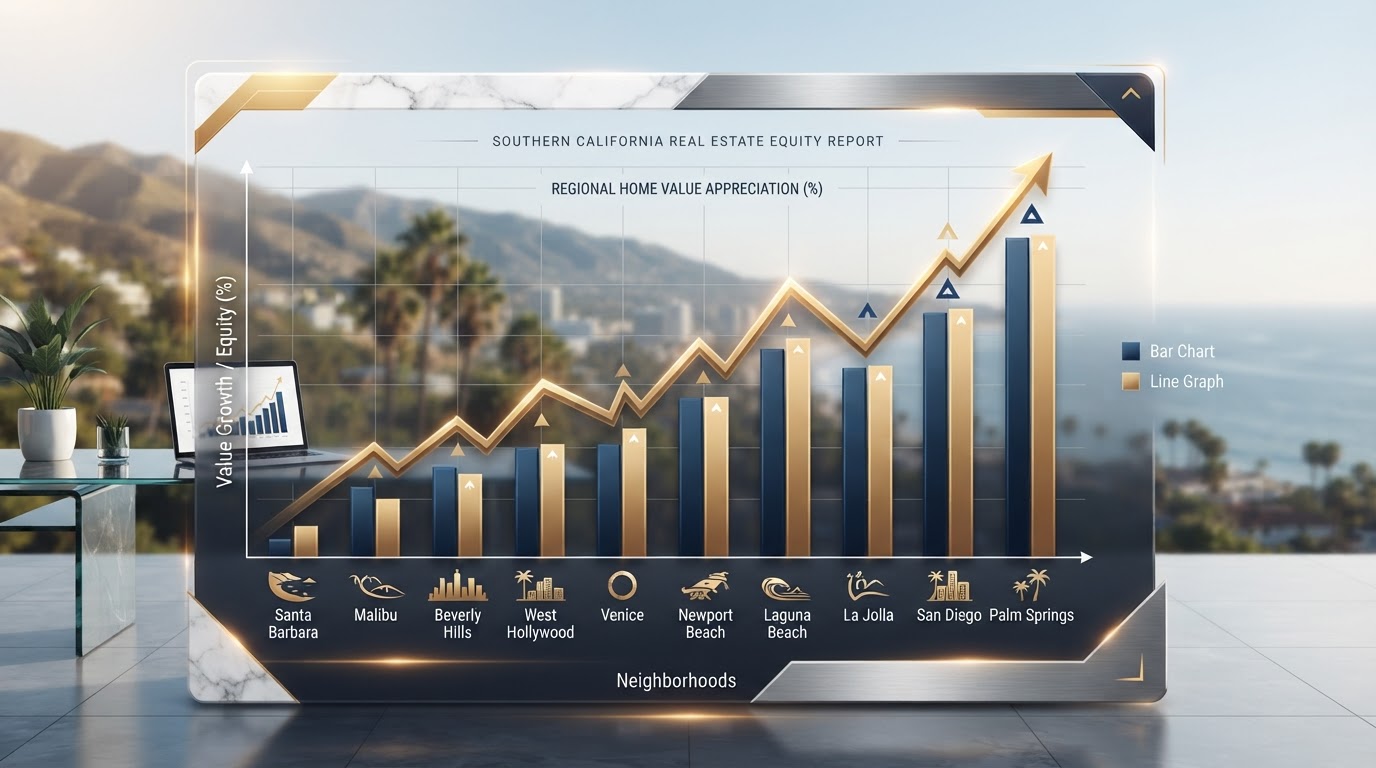
Values have not risen uniformly. The gains vary meaningfully by county, driven by affordability, migration patterns, and local supply dynamics. Here is how the major Southern California counties have trended over the last year.
Orange County
Orange County remains the premium market in the region, with a median home price now around $1.4 million. Year-over-year values have grown roughly 4% to 5%. The affordability constraint is real here, with only about 15% of households able to qualify for the median-priced home, but the constrained supply and strong demand from high-income buyers keep values firm. A homeowner who bought five years ago has likely seen equity gains of $300,000 to $500,000 depending on the property and location.
San Diego County
San Diego's median price sits near $950,000, with year-over-year growth of roughly 5% to 6%. San Diego benefits from a diversified economy, coastal desirability, and limited buildable land near the coast. The inland North County communities have seen some of the strongest appreciation as buyers push east for relative affordability. Five-year equity gains for typical owners are in the $200,000 to $350,000 range.
Riverside County (Inland Empire)
The Inland Empire is the standout story of 2026. With a median price around $580,000, Riverside County has seen year-over-year growth of roughly 6% to 7%, among the highest in the region. This is affordability-driven migration in action. Buyers priced out of the coast are moving inland, and the transaction volume here is the healthiest in Southern California. Owners who bought in the Inland Empire five years ago have often seen equity gains of $150,000 to $250,000, a remarkable percentage return on a more affordable entry point.
San Bernardino County
San Bernardino mirrors Riverside's story, with a median price near $520,000 and year-over-year growth of roughly 6%. The eastern Inland Empire continues to attract buyers seeking the most affordable path to Southern California homeownership. Equity gains for five-year owners typically run $130,000 to $220,000.
Los Angeles County
Los Angeles, the largest market, has a median price near $880,000 with year-over-year growth of roughly 3% to 4%. The sheer size and diversity of LA means gains vary widely by neighborhood, with some coastal and Westside areas outperforming and some inland areas lagging. Five-year equity gains for typical owners are in the $150,000 to $300,000 range.
What Is Driving Your Equity
If you have owned for five or more years, your equity comes from three sources stacking on top of each other.
Principal paydown. Every mortgage payment you have made has reduced your loan balance. On a 30-year loan, the principal paydown is slow in the early years, but it accelerates over time and compounds with the other factors.
Appreciation. Your home's market value has risen. In Southern California, the long-term appreciation trend has been remarkably consistent, and the 2026 gains, while moderate, are still positive in most areas.
Rate lock-in premium. This is the newest and least understood source of equity. If you hold a mortgage below 5%, that low-rate loan itself has become a valuable asset. A buyer assuming your payment structure would face a dramatically higher cost at today's rates, which effectively makes your home more valuable to you than its market price suggests. This is why many owners are choosing to stay and renovate rather than sell.
What This Means If You Are Thinking About Selling
If you have been in your home for five or more years, you are likely sitting on substantial equity. That changes the math on selling in several ways.
You have options you did not have before. Equity gives you the flexibility to move up, downsize, relocate, or pull cash out for other goals. You are not trapped by being underwater, which was the reality for many owners in the 2007-2013 period.
Your sale price is not your profit. This is the mistake I see most often. Owners see their home value up by $300,000 and think that is their gain. It is not. Your net proceeds depend on your remaining loan balance, closing costs, agent commissions, prep and repair costs, and any concessions you negotiate. Running a true net sheet before you list is essential.
Timing matters less than readiness. In a market where values are trending up modestly, the cost of waiting another year is small relative to the cost of selling unprepared. The bigger risk is not selling at the wrong time, it is selling without maximizing your equity through proper prep, pricing, and marketing.
The rate lock-in cuts both ways. If you sell and buy again, you give up your low rate and take on a higher one. For some owners, that is reason enough to stay and renovate. For others, the life change driving the sale, a relocation, a downsizing, a divorce, an inheritance, makes the rate trade-off worth it. The point is to make that decision consciously, with the numbers in front of you.
How to Find Out What Your Home Is Worth Right Now
The county-level numbers above tell you the trend, but they do not tell you what your specific home is worth. Every property is different, and your equity depends on your home's condition, location, upgrades, lot size, and the micro-market of your immediate neighborhood.
The only way to know your real equity position is to get a current, property-specific valuation. That means a comparative market analysis from a local agent who knows your area, combined with a payoff statement from your lender showing your remaining balance.
If you are curious where you stand, that is the first step. No obligation, no pressure to list. Just the number that matters most when you are deciding whether to stay or go.
Rory's Take
I talk to homeowners every week who are genuinely surprised by how much equity they have. They have been focused on the rate environment and the headlines about a slow market, and they have missed the fact that their own home has been gaining value the entire time. The 2026 market is not a boom, but it does not need to be. Steady appreciation on top of years of prior gains, plus principal paydown, plus the value of a low-rate loan, adds up to real wealth for anyone who has owned for five or more years.
If you are thinking about selling, the equity is there. The question is whether this is the right time in your life to use it, and whether you will take the steps to capture all of it rather than leaving money on the table. That is a conversation worth having before you make a move.
Frequently Asked Questions
How much equity do Southern California homeowners have in 2026?
It varies by county and how long you have owned, but typical five-year owners in the region have seen equity gains ranging from $130,000 in the Inland Empire to over $500,000 in premium Orange County markets. The exact figure depends on your purchase price, loan balance, and local appreciation.
Why are home values still rising when rates are high?
Inventory is historically low because most existing homeowners hold mortgage rates below 5% and have little incentive to sell. That constrained supply, combined with the region's long-term housing shortage, supports values even as higher rates reduce the number of active buyers.
Which Southern California county has gained the most equity in 2026?
The Inland Empire, Riverside and San Bernardino counties, has seen the highest percentage year-over-year growth, roughly 6% to 7%, driven by affordability-driven migration from the coast. Orange County has the largest dollar gains due to its higher price points.
Is my low mortgage rate part of my equity?
In effect, yes. If you hold a rate below 5%, that loan is a valuable asset because replacing it at today's rates would cost significantly more. This rate lock-in premium is one reason many owners are choosing to stay and renovate rather than sell and rebuy at a higher rate.
How do I find out exactly how much equity I have?
Get a current comparative market analysis for your specific property and request a payoff statement from your lender. The difference between your home's current value and your remaining loan balance, minus selling costs, is your real equity position.
Curious what your home is worth right now? Get a free home valuation or contact Compadre Brokers for a no-obligation equity review.