The Concession That Beats a Price Cut
If you are shopping for a home in Southern California right now, you already know the obstacle. Mortgage rates are sitting in the mid-6% to 7% range, and that monthly payment is what keeps most buyers on the sidelines. Sellers know it too. They know their pool of qualified buyers is smaller than it was a few years ago, and they know that something has to give to get a deal closed.
The smart sellers are not just slashing their price. They are using a tool that helps you, the buyer, far more than a price reduction would. It is called a rate buydown, and specifically the 2-1 buydown, and it is the single most effective concession being negotiated in today's market.
Here is what it is, why it works, and how to use it.
What Is a Rate Buydown?
A rate buydown is a seller-paid concession that temporarily lowers your mortgage interest rate for the first few years of the loan. The seller pays a lump sum at closing to a lender, and that money is used to subsidize your monthly payment for a set period.
The most common structure is the 2-1 buydown. Here is how it works:
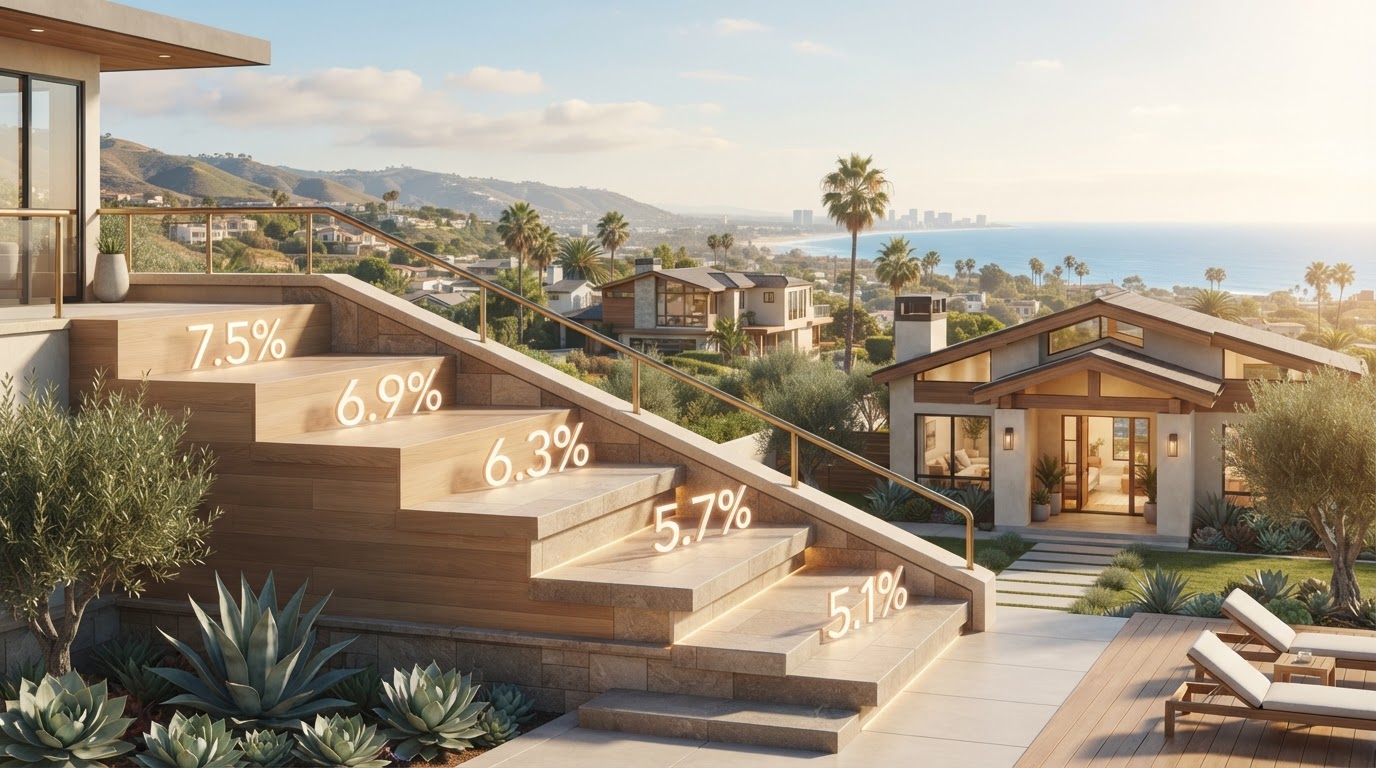
- Year 1: Your interest rate is reduced by 2 full percentage points below the note rate.
- Year 2: Your interest rate is reduced by 1 percentage point.
- Year 3 and beyond: Your rate returns to the original note rate for the remainder of the loan.
So if you lock a 7% mortgage, a 2-1 buydown drops you to 5% for year one and 6% for year two, before settling at 7% in year three.
There is also a 3-2-1 buydown (3% off year one, 2% off year two, 1% off year three) and a 1-0 buydown (1% off year one only). The 2-1 is the sweet spot most commonly negotiated because it balances meaningful savings with a reasonable cost to the seller.
The Real Savings: A SoCal Example
Let us put real numbers on it. Say you are buying a $750,000 home in Riverside County with 10% down, financing $675,000 at a 7% note rate.
- Without a buydown, your principal and interest payment at 7% is roughly $4,490 per month.
- Year 1 with a 2-1 buydown at 5%, that payment drops to roughly $3,622. That is a savings of about $867 per month, or over $10,400 in the first year alone.
- Year 2 at 6%, the payment is roughly $4,048, saving you about $442 per month, or roughly $5,300 for the year.
Over the first two years, you save roughly $15,700 in payments. That is real cash back in your pocket every month, at exactly the time when most buyers feel the most stretched.
The cost to the seller to fund that buydown? Typically between $15,000 and $20,000, paid as a one-time fee at closing. Here is the key insight: that same $15,000 to $20,000, if applied as a price reduction instead, would lower your loan amount by roughly that much and reduce your monthly payment by only about $100. The buydown delivers dramatically more monthly relief per dollar spent.
Why Sellers Prefer It Over a Price Cut
This is the part most buyers do not expect. Sellers often prefer funding a buydown over dropping their list price, for several reasons.
It preserves the comparable sale value. A price reduction lowers the recorded sale price, which can drag down the appraised value and the comps for the neighborhood. A buydown keeps the sale price intact, protecting the seller's equity and the neighbor's values.
It costs the seller less in net proceeds than an equivalent price cut. Because the buydown subsidizes the rate rather than the principal, the seller spends less to give the buyer more monthly relief. It is a more efficient use of concession dollars.
It gets the deal done. In a market where affordability is the barrier, the buydown directly attacks that barrier. A buyer who was priced out at 7% becomes qualified and comfortable at 5%. The transaction closes.
How to Ask for a Buydown in Your Offer
If you are writing an offer in today's market, a seller-paid 2-1 buydown should be on your list of requested concessions, especially on homes that have been sitting or in price ranges where affordability is tight.
- Get your lender to price it. Before you ask for it, have your loan officer calculate the exact cost of a 2-1 buydown at your note rate and loan amount. You need a specific dollar figure to put in the offer.
- Frame it as a win-win. Present it to the seller as a concession that costs them less than a price cut while getting you to a comfortable payment. Your agent should make the math case explicitly.
- Build it into the offer terms. The buydown is typically written as a seller credit at closing, earmarked for the buydown fee. Your lender and agent will structure the language.
- Negotiate the rate, not just the price. If a seller counters your offer, consider trading a small price concession for a fully funded buydown instead. The monthly impact is usually greater.
- Understand the reset. Know going in that your payment steps up in year two and again in year three. Budget for the full note rate payment, not the discounted one, so you are never surprised.
What Happens After the Buydown Period Ends
The most common question I get is what happens in year three when the rate resets to the full note rate. The answer is that you are not stuck there.
If rates fall over the next two years, as many economists expect they gradually will, you refinance into a lower permanent rate before the buydown expires. The buydown essentially buys you time and breathing room while you wait for the rate environment to improve.
If rates do not fall, you have still benefited from two years of lower payments, during which your income has likely grown, you have built equity through principal paydown and appreciation, and the payment at the note rate feels more manageable than it would have on day one.
Either way, the buydown put you in the home two years earlier than you otherwise would have been able to afford, and those two years of equity building and life lived in your own home are worth something.
Who Qualifies for a Buydown?
Buydowns are available on most conventional, FHA, and VA loans, with some specific rules. The lender must qualify you at the full note rate, not the discounted rate, to ensure you can afford the payment when it resets. That is an important protection built into the program.
For FHA loans, the buyer must qualify at the note rate, and the buydown cannot exceed 2 percentage points per year. For VA loans, similar qualifying rules apply. Your lender will walk you through the specifics for your loan type.
The key point is that the buydown is not a trick to get you into a payment you cannot afford. It is a bridge that lowers your cost during the most expensive early years of homeownership, with the expectation that your financial position improves over time.
Rory's Take
In a 3% rate world, nobody needed a buydown. In a 7% rate world, it is often the thing that makes the deal work for both sides. I have seen sellers who refused to touch their price happily fund a 2-1 buydown once they understood it cost them less and preserved their sale price. And I have seen buyers who were ready to walk away get into a home they love because the buydown brought the payment into reach.
If you are buying this fall, do not just negotiate on price. Negotiate on rate. A seller-paid buydown is one of the most powerful tools available to you right now, and too few buyers even know to ask for it.
Frequently Asked Questions
What is a 2-1 rate buydown?
A 2-1 buydown is a seller-paid concession that lowers your mortgage rate by 2 percentage points in year one and 1 percentage point in year two, before returning to the original note rate in year three. It reduces your monthly payment during the most expensive early years of the loan.
Who pays for a rate buydown?
The seller pays for it as a closing credit. The cost is a lump sum, typically funded from the seller's proceeds at closing, and it is used by the lender to subsidize your monthly payment during the buydown period.
Is a buydown better than a price reduction?
For most buyers, yes. A buydown delivers significantly more monthly payment relief per dollar than a price reduction, because it subsidizes the interest rate rather than reducing the loan principal. A $15,000 buydown can save you more per month than a $15,000 price cut.
Can I refinance after a buydown?
Yes. If rates fall before your buydown period expires, you can refinance into a lower permanent rate. The buydown essentially buys you time at a lower payment while you wait for the rate environment to improve.
Do I have to qualify at the full rate?
Yes. Lenders qualify you at the note rate, not the discounted rate, to ensure you can afford the payment when it resets. This protects you from getting into a loan you cannot sustain.
Shopping for a home this fall? Search Southern California listings or contact Compadre Brokers to structure an offer with a seller-paid rate buydown that gets you to a payment you can live with.